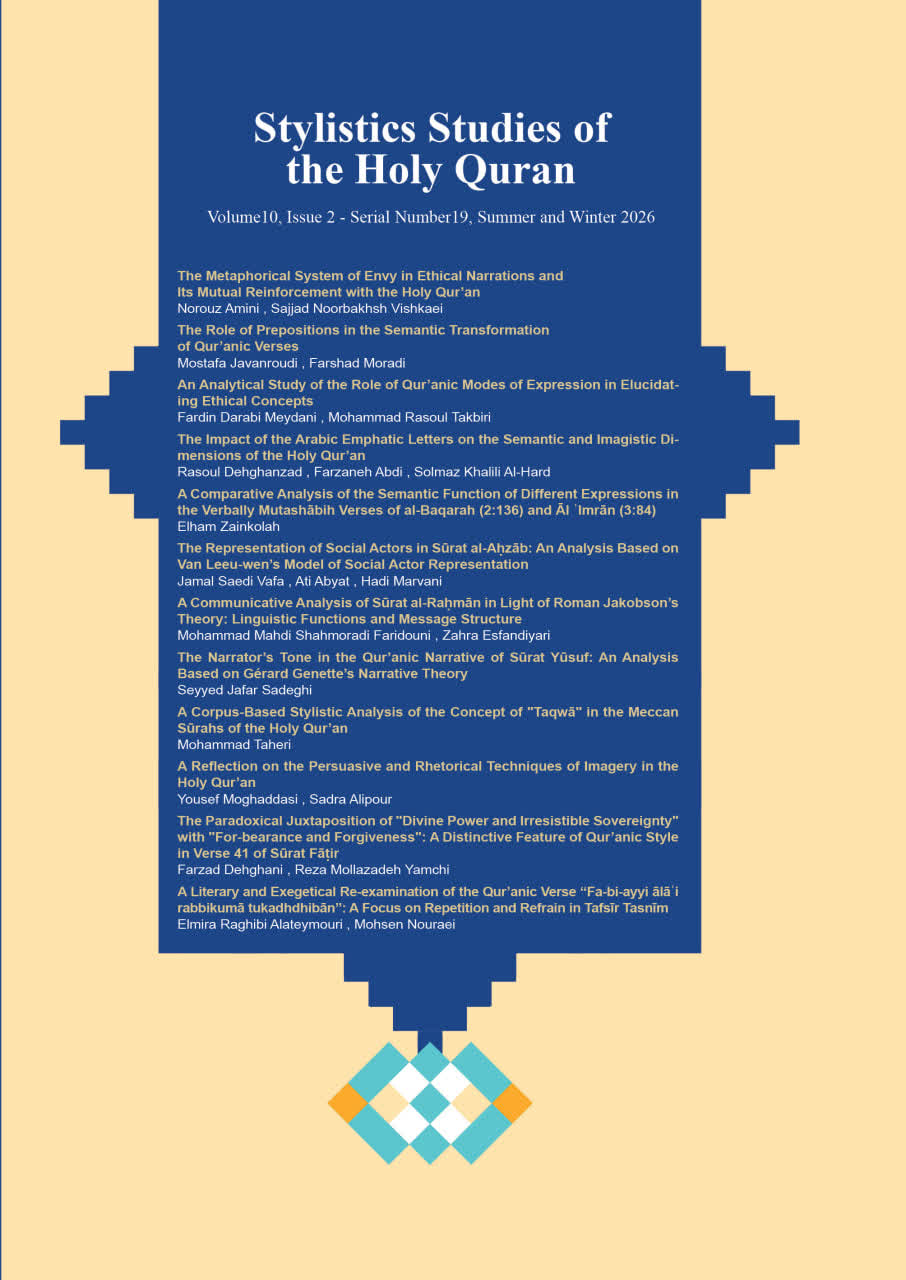
Stylistics Studies of the Holy Quran

Stylistics Studies of the Holy Quran

The Representation of Social Actors in Sūrat al-Aḥzāb: An Analysis Based on Van Leeuwen’s Model of Social Actor Representation

Document Type : Original Article

Authors
1 Visiting Professor, Hazrat Rasool Akram (PBUHH) Campus, Farhangian University, Khuzestan, Iran.
2 Associate Professor, Department of Arabic Language and Literature, Farhangian University, Tehran, Iran.
3 Bachelor’s Degree in Arabic Language Education, Hazrat Rasool Akram (PBUH) Campus, Khuzestan, Iran.
Abstract
Extended Abstract
Research Objective: This study aims to analyse the representation of social actors in Sūrat al-Aḥzāb (Qur’an 33) through the lens of Theo van Leeuwen’s framework for the discursive construction of social actors. As one of the significant theoretical frameworks in critical discourse analysis, this model examines how individuals, groups, and institutions are represented in texts and seeks to uncover the underlying linguistic and discursive mechanisms involved in their representation. Since the Holy Qur’an, as a religious, cultural, and identity-forming text, plays a significant role in shaping the social and value systems of Muslim societies, analyzing its discourse can contribute to a better understanding of power relations, identity construction, and value orientations within Islamic society.
Sūrat al-Aḥzāb (Qur’an 33) is a Medinan Sūrah revealed in connection with various social, political, familial, and ethical issues. It addresses significant subjects, including the Battle of the Confederates (Ghazwat al-Aḥzāb), the Prophet’s role in Muslim society, the status of women, and the conduct of hypocrites. Through specific linguistic structures, the sūrah delineates identity boundaries between believers and non-believers, strengthens social cohesion, and reinforces Islamic values. Accordingly, selecting this sūrah for an analysis of the discursive representation of social actors can reveal various dimensions of linguistic and discursive construction.
Research Method: This study adopts a qualitative, descriptive-analytical approach. Its data comprise the verses of Sūrat al-Aḥzāb, which are examined in light of van Leeuwen’s theoretical framework and its analytical categories. These include deletion, nomination, identification, and role allocation, among others. Using these categories, the study examines how social actors are represented in the Qur’anic text and demonstrates how the linguistic structures employed in the Sūrah convey ideological, ethical, and identity-related meanings.
Findings: The findings indicate that social actors in Sūrat al-Aḥzāb (Qur’an 33) are represented in ways that serve the Qur’an’s educational, ethical, and political objectives. The Prophet of Islam (PBUHH) is presented as the central social actor and is characterized by obedience to God, guidance, patience, exemplary conduct, and his role as a focal point of unity within Muslim society. Believers, in turn, are represented through attributes such as loyalty, truthfulness, steadfastness, self-sacrifice, and obedience to the Prophet. By contrast, hypocrites and the enemies of Islam are characterized by hypocrisy, fear, instability, betrayal, divisiveness, and attempts to undermine the Muslim community. Muslim women are also represented as active and responsible social actors in both the social and familial spheres. Their roles in maintaining moral boundaries, observing hijab, obeying the Prophet, and participating in the social structure are particularly emphasized.
Another significant finding concerns the deletion and indirect reference of certain social actors, which reflect particular discursive orientations within the text. Such omissions generally occur in references to the enemies of Islam or hypocrites and contribute to strengthening the collective identity of believers while undermining the position of their opponents. Furthermore, specific nomination strategies and the use of evaluative attributes to describe social actors play an important role in shaping the audience’s perceptions of them and reinforcing Islamic values. Similarly, the allocation of active roles to believers and passive or negative roles to hypocrites reflects the text’s value orientation and contributes to the reinforcement of Islamic discourse.
Conclusion: The study demonstrates that Sūrat al-Aḥzāb (Qur’an 33) employs discursive structures to represent social actors in a purposeful manner. Through specific linguistic mechanisms, it contributes to reinforcing Islamic values, strengthening religious identity, and delineating ethical and social boundaries. These representations not only serve the Qur’an’s religious and educational objectives but also reveal the discursive complexities of the sacred text in addressing the social and political issues of the period of revelation. Analyzing these structures can contribute to a better understanding of the role of language in shaping identities and power relations in religious texts and provide a basis for comparative studies in the field of religious discourse.
Keywords
Subjects

The Holy Qur’an
Aghagolzadeh, F. (2006). Critical discourse analysis. Tehran: Scientific and Cultural Publishing. [In Persian]
Al‑Riyami, A. H. (2019). Discourse analysis: Concept and methodology. Journal of the Faculty of Islamic and Arabic Studies for Women in Zagazig, 9(2), 1405–1432. https://doi.org/10.21608/JFAZ.2019.67475 (doi.org in Bing) [In Arabic]
Arab Yousefabadi, A.; Abdollahzadeh, F.; Afzali, F. (2018). Linguistic discourse analysis of Surah Al‑Jinn: A statistical study. Quranic Knowledge Research Journal, 9(33), 139–162. [In Persian]
Arab Yousefabadi, A.; Barabadi, E.; Mirzadeh, T. (2017). Discourse structures in Surah Al‑Qasas based on Van Leeuwen’s model. Quranic Literary Studies, 5(3), 39–62. [In Persian]
Arab Yousefabadi, F.; Davar, Z. (2022). Critical discourse analysis of Asrar al‑Tawhid based on Van Leeuwen’s model. Journal of Mystical Literature Studies, 15(47), 153–166. [In Persian]
Asadi, M.; Arslan, G.; Aghagolzadeh, F.; Afrashi, A. (2015). Linguistic and socio‑semantic components and representation of social actors in press texts. Linguistic Essays, 23(2), 1–24. [In Persian]
Bashir, H. (2006). Discourse analysis: A gateway to uncovering the unspoken. Tehran: Imam Sadiq University. [In Persian]
Bosse, B.; Montoro, R.; Nørgaard, N. (2021). Stylistics dictionary (A. R. Jamkarani & M. Farhamandfar, Trans.). Tehran: Morvarid Publishing. [In Persian]
Fairclough, N. (2018). Critical discourse analysis (F. Shayesteh Piran et al., Trans.). Tehran: Center for Media Studies and Research. [In Persian]
Fallahi, M. H.; Sahebi, S.; Tavakoli, N. (2010). Narrative critique of Golestan based on critical discourse analysis theory. Persian Language and Literature Research, 4(16), 109–133. [In Persian]
Hartley, J., et al. (2006). Key concepts in communication (M. Ra’eeszadeh, Trans.). Tehran: Fasl‑e No Publishing. [In Persian]
Hammouda, M. (1998). Al‑Ijaz fi al‑Balaghah al‑Arabiyyah. Cairo: Dar al‑Ma’arif. [In Arabic]
Hosseini Qaleh Bahman, S. A. (2022). Ethical principles of social activism among clerics in Shiite teachings and Catholic doctrine. Applied Ethics Studies, 11(66), 11–43. [In Persian]
Karimi Firouzjaei, A.; Naeimi, F. (2017). Discourse analysis of social justice from Imam Khomeini’s perspective based on Van Leeuwen’s socio‑semantic approach. Journal of Islamic Revolution Studies, 19(74), 129–150. [In Persian]
Leeuwen, T. van (1996). The representation of social actors. In C. R. Caldas‑Coulthard & M. Coulthard (Eds.), Texts and practices: Readings in CDA. London: Routledge.
Leeuwen, T. van (2005). Introduction to social semiotics (M. Nobakht, Trans.). Tehran: Elmi Publishing. [In Persian]
Leeuwen, T. van (2008). Discourse and practice: New tools for critical discourse analysis. Oxford University Press.
Meghdari, S.; Jahangiri, Sh. (2015). Critical discourse analysis of Sacred Defense poetry for children based on Van Leeuwen’s approach. Literary Text Research, 19(65), 121–160. [In Persian]
Molla Ebrahimi, E.; Azizi Morad, G.; Tarafi Salmani, K.; Karim, Z. (2024). Critical discourse analysis based on Van Leeuwen’s model: The story of Prophet Moses in Surah Taha. Quranic Literary Research Quarterly, 11(43), 1–20. [In Persian]
Mozaffari, S.; Asoudi, A.; Yazdan, H. (2020). Discourse structures in Surah Maryam based on Van Leeuwen’s model. Stylistic Studies of the Holy Qur’an, 3(4), 178–190. [In Persian]
Normandipour, M.; Ansari, N.; Al‑Bouyeh Langroudi, A. (2024). Representation of social actors in the Sermon of Shaqshaqiyyah based on Van Leeuwen’s socio‑semantic model. Nahj al‑Balagha Research Journal, 11(43), 36–58. [In Persian]
Pahlavan, M. R.; Sahragard, R.; Fallahi, M. H. (2009). Modes of representing social actors in Constitutional‑Era periodicals from the perspective of critical discourse analysis. Linguistics and Dialects of Khorasan, 51–73. [In Persian]
Richardson, J. E. (2007). Analyzing newspapers: An approach from critical discourse analysis. New York: Palgrave Publishing.
Saeednia, N.; Asadi, M.; Andi, S. T. (2014). Representation of women in the novels Savushun and The Patience Stone from the perspective of critical discourse analysis. Proceedings of the 9th Iranian Linguistics Conference, 4(10), 687–704. [In Persian] 
Van Dijk, T. (2003). Studies in discourse analysis: From text grammar to critical discourse analysis (Group of Translators, Trans.). Tehran: Center for Media Studies and Research. [In Persian]
Yarmohammadi, L. (2004). Mainstream and critical discourse analysis. Tehran: Hermes. [In Persian]
ـــــــــــــــــــــــــــــــــــــ (2009). Communication from the perspective of critical discourse analysis. Tehran: Hermes. [In Persian]
ـــــــــــــــــــــــــــــــــــــ (2010). Introduction to discourse analysis. Tehran: Hermes. [In Persian]
Volume 10, Issue 2 - Serial Number 19
Volume10, Issue 2 - Serial Number19, Summer And Winter 2026
October 2026
Pages 130-161

  • Receive Date 14 July 2025
  • Revise Date 20 September 2025
  • Accept Date 22 September 2025
  • Publish Date 23 October 2026