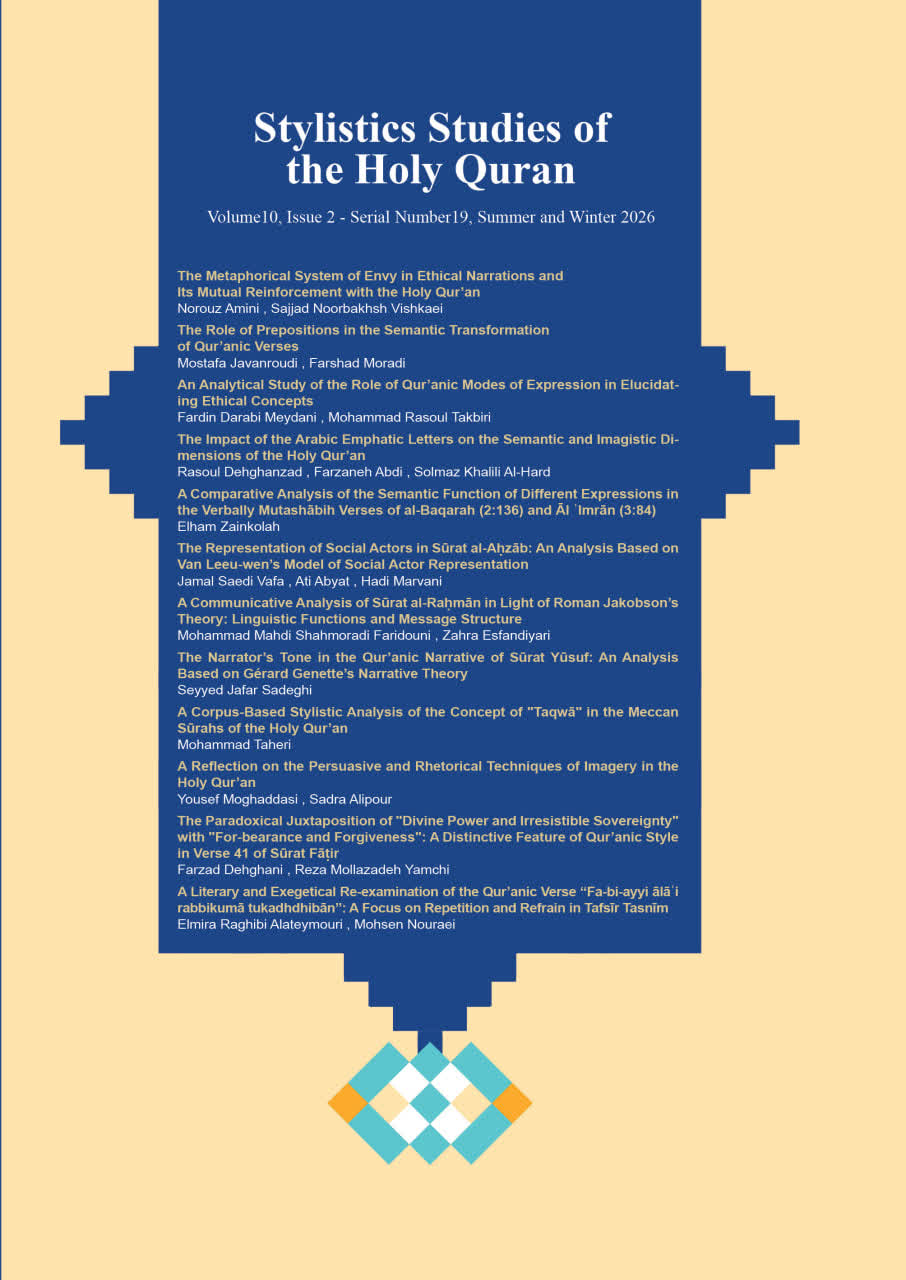
Stylistics Studies of the Holy Quran

Stylistics Studies of the Holy Quran

A Comparative Analysis of the Semantic Function of Different Expressions in the Verbally Mutashābih Verses of al-Baqarah (2:136) and Āl ʿImrān (3:84)

Document Type : Original Article

Author
Assistant Professor, Department of Qur’anic and Hadith Sciences, Eqlid Higher Education Centre, Iran
Abstract
Extended Abstract
Research Objective: Examining and analyzing Qur’anic expressions and terminology, particularly in verses exhibiting verbal similarities (mutashābihāt lafẓiyyah), is of particular importance. Accordingly, this study seeks to deepen understanding and elucidate the less apparent dimensions of such verses through an exegetical and comparative analysis of verses 136 of Sūrat al-Baqarah (Qur’an 2) and 84 of Sūrat Āl ʿImrān (Qur’an 3). Its primary objective is to identify and explain the rationale behind the differences in their wording and the semantic significance of these variations.
Research Method: Verses exhibiting verbal similarities are those that resemble one another in wording and lexical structure despite certain differences in their expressions. Verses 136 of Sūrat al-Baqarah and 84 of Sūrat Āl ʿImrān exemplify this phenomenon. Although both address the general theme of belief in God and the divine prophets, they differ in several key expressions. Given the importance of recognizing these differences for a more comprehensive understanding of the two verses, this study adopts a library-based approach to data collection and documentary analysis. Through a comparative examination of the verses and an identification of their distinguishing linguistic features, it seeks to explain the reasons for these differences and their respective semantic functions.
Findings: The findings indicate that verse 136 of Sūrat al-Baqarah (Qur’an 2), in light of its context—particularly the disputes between the People of the Book and the Muslims, during which the former asserted their superiority—employs the plural imperative qūlū (Say), enabling Muslims to respond to the People of the Book. The general scope of this plural address accounts for the subsequent use of the preposition ilā (to), which indicates the destination of revelation as reaching the people. It also explains the repetition of the verb ūtī (was given), given the general nature of the addressees and the need for a more detailed formulation.
By contrast, verse 84 of Sūrat Āl ʿImrān (Qur’an 3) occurs in the context of verses addressing the confrontation between the People of the Book and the Prophet (PBUHH). Accordingly, in responding to and refuting their statements, the verse emphasizes the Prophet’s elevated status by beginning with the singular imperative qul (Say). Moreover, within this context, just as a covenant was taken from the other prophets to affirm their mutual confirmation, a separate covenant was also taken from the Prophet of this community. This further underscores the significance of the singular form of address.
This direct address, together with its emphasis on the Prophet’s responsibility and the direct revelation of divine messages to him, accounts for the selection of the preposition ʿalā (upon), which conveys the notion of elevation or being upon something. It also explains the omission of the verb ūtī, since the addressee is specifically the Prophet and further elaboration is therefore unnecessary. Thus, the differences in the wording of these two verses do not constitute mere stylistic variations or arbitrary lexical choices. Rather, each expression carries a particular semantic significance in accordance with the context and purpose of its respective verse, such that the expressions are not interchangeable without affecting their intended meanings.
Conclusion: The verses under consideration belong to the category of Qur’anic verses exhibiting verbal similarities, yet they differ in their forms of address, the prepositions accompanying the verb, and the degree of verbal elaboration. Specifically, in verse 136 of Sūrat al-Baqarah, the plural imperative qūlū is used in accordance with the context and the general scope of the address. In verse 84 of Sūrat Āl ʿImrān, however, the singular imperative qul is employed to emphasize the Prophet’s elevated status, confront and refute the statements of the People of the Book, and reflect the fact that a covenant was taken from him, just as it was from the other prophets.
Similarly, the preposition accompanying the verb in Sūrat al-Baqarah (Qur’an 2) is ilā, which is consistent with the plural form of address and indicates the conveyance of the message and Scripture to the community as their ultimate destination. In Sūrat Āl ʿImrān (Qur’an 3), by contrast, the preposition ʿalā is used because the address is directed to the Prophet and the revelation is conveyed directly to him. Furthermore, the verb ītāʾ (giving) is repeated in verse 136 of Sūrat al-Baqarah because of the general nature of the address and the absence of sufficient preparatory context in the preceding verses. In verse 84 of Sūrat Āl ʿImrān, however, the addressee is specific, and the necessary contextual groundwork has already been established in the preceding verses. Hence, there is no need to elaborate the statement or repeat this verb.
Since the context and discursive setting of each verse differ, their expressions cannot be interchanged without altering or diminishing the message and meaning of the respective verse. Preserving these differences is therefore essential for a proper understanding of the verses and the accurate interpretation of their messages and semantic nuances. The expressions in question are interconnected in a chain-like manner: besides being meaningfully arranged through collocation, their selection follows a logical pattern of substitution. They are employed with such precision in their respective contexts that they cannot be substituted for one another. Nor can an expression be removed from one verse and inserted into the other without affecting its contextual and semantic function.
Although the use of anzala (to send down) with ilā in Sūrat al-Baqarah indicates the conveyance of the message to the people as its ultimate destination, whereas its use with ʿalā in Sūrat Āl ʿImrān refers to the direct descent of revelation upon the Prophet (PBUHH), this distinction does not constitute a universal rule. Indeed, numerous instances in the Qur’an demonstrate otherwise. The use of anzala with either of these prepositions therefore depends on the context, the discursive setting of the verses, and the intended addressee.
Keywords
Subjects

The Holy Qur'an.
Ibn al‑Zubayr, Ahmad ibn Ibrahim (1403 A.H.). Mīzān al‑Ta’wīl fī Mutashābih al‑Lafẓ min Āy al‑Tanzīl (The Criterion of Interpretation in Ambiguous Expressions of Qur’anic Verses). Beirut: Dār al‑Gharq al‑Islāmī, 1st ed.
Ajhūrī, ‘Aṭiyyah (1430 A.H.). Irshād al‑Raḥmān li‑Asbāb al‑Nuzūl wa‑al‑Nāsiḫ wa‑al‑Mansūkh wa‑al‑Mutashābih wa‑Tajwīd al‑Qur’ān (Guidance of the Merciful on the Causes of Revelation, Abrogating and Abrogated, Ambiguities, and Qur’anic Recitation). Casablanca: Markaz al‑Turāth al‑Thaqāfī al‑Maghribī, 1st ed.
al‑Iskāfī, Muhammad ibn ‘Abd Allāh (1422 A.H.). Durat al‑Tanzīl wa‑Ghurat al‑Ta’wīl fī Bayān al‑Āyāt al‑Mutashābihāt fī Kitāb Allāh al‑‘Azīz (The Pearl of Revelation and the Brightness of Interpretation in Explaining the Ambiguous Verses). Beirut: Dār al‑Ma‘rifah, 1st ed.
Ibn Fāris, Ahmad (1404 A.H.). Mu‘jam Maqāyīs al‑Lughah (Dictionary of Linguistic Scales). Qom: Maktabat al‑I‘lām al‑Islāmī.
Ibn al‑Nadīm, Muhammad ibn Isḥāq (n.d.). al‑Fihrist (The Catalogue). Beirut: Dār al‑Ma‘rifah.
al‑Andalusī, Abu Ḥayyān (1420 A.H.). al‑Baḥr al‑Muḥīṭ fī al‑Tafsīr (The Comprehensive Ocean in Qur’anic Exegesis). Beirut: Dār al‑Fikr, 1st ed.
Taji, Mahdieh. (1403 A.H.). “An Analysis of Verbal Ambiguities in Surah al-Baqarah Based on the Modern Approach of Cognitive Semantics.” Qur’anic Thought of Contemporary Thinkers, 1(1), Spring–Summer, 33–58.
al‑Tha‘ālabī, ‘Abd al‑Raḥmān ibn Muhammad (1418 A.H.). al‑Jawāhir al‑Ḥisān fī Tafsīr al‑Qur’ān (The Precious Jewels in Qur’an Commentary). Beirut: Dār Iḥyā’ al‑Turāth al‑‘Arabī, 1st ed.
Javadi Amoli, ‘Abdollah (1401 A.H.). Tasnīm: Tafsīr al‑Qur’ān al‑Karīm (Tasnīm: Exegesis of the Holy Qur’an). Qom: Nashr‑e Esrā’, 9th ed.
——— (1398 A.H.). Tasnīm: Tafsīr al‑Qur’ān al‑Karīm. Qom: Nashr‑e Esrā’, 5th ed.
 Hosseini, Bibi Zeynab, & Rezaei Kermani, Mohammad Ali. (1387 A.H.). “A Study of Verbal Ambiguities in the Holy Qur’an.” Islamic Studies: Qur’anic Sciences and Hadith, 40(81), 83–110.
Rajabī, Mahmoud (1385 A.H.). Methodology of Qur’anic Interpretation. Qom: SAMT Publications.
Al-Zarkashi, Muhammad ibn Bahadir. (1410 A.H.). Al-Burhan fi ‘Ulum al-Qur’an. Beirut: Dar al-Ma‘rifah.
al‑Zamakhsharī, Mahmoud (1407 A.H.). al‑Kashshāf ‘an Ḥaqā’iq Ghawāmiḍ al‑Tanzīl (The Revealer of Realities of the Qur’anic Secrets). Beirut: Dār al‑Kutub al‑‘Arabī, 3rd ed.
al‑Suyūṭī, ‘Abd al‑Raḥmān (1406 A.H.). Tanāsuq al‑Durrar fī Tanāsub al‑Suwar (The Harmony of Pearls in the Order of Chapters). Beirut: Dār al‑Kutub al‑‘Ilmiyyah, 1st ed.
——— (1414 A.H.). Qaṭf al‑Azhar fī Kashf al‑Asrār (Gathering the Blossoms in Unveiling the Mysteries). Doha: Ministry of Endowments and Islamic Affairs, 1st ed.
al‑Ṭabāṭabā’ī, Muhammad Ḥusayn (1417 A.H.). al‑Mīzān fī Tafsīr al‑Qur’ān (The Scale in Qur’anic Commentary). Qom: Islamic Seminary Teachers Association Press, 5th ed.
al‑Ṭabrisī, Faḍl ibn Ḥasan (1372 A.H.). Majma‘ al‑Bayān fī Tafsīr al‑Qur’ān (The Comprehensive Compilation in Qur’anic Exegesis). Tehran: Amīr Kabir Publications, 3rd ed.
——— (1412 A.H.). Tafsīr Jawāmi‘ al‑Jāmi‘ (The Comprehensive Exegesis). Qom: Ḥawzah ‘Ilmiyyah Press, 1st ed.
al‑Ṭurayḥī, Fakhr al‑Dīn (1403 A.H.). Majma‘ al‑Baḥrayn (The Confluence of the Two Seas). Beirut: Dār Iḥyā’ al‑Turāth al‑‘Arabī.
al‑Ṭūsī, Muhammad ibn al‑Ḥasan (1409 A.H.). al‑Tibyān fī Tafsīr al‑Qur’ān (The Clarification in Qur’anic Exegesis). Beirut: Dār Iḥyā’ al‑Turāth al‑‘Arabī.
al‑Anṣārī, Zakarīyā ibn Muhammad (1424 A.H.). Fatḥ al‑Raḥmān Sharḥ Mā Yulbas min al‑Qur’ān (The Opening of the Merciful: Explanation of Qur’anic Ambiguities). Beirut: Dār al‑Kutub al‑‘Ilmiyyah, 1st ed.
al‑Fayrūzābādī, Muhammad ibn Ya‘qūb (1416 A.H.). Baṣā’ir Dhawī al‑Tamīz fī Laṭā’if al‑Kitāb al‑‘Azīz (Insights of the Discerning into the Subtleties of the Noble Book). Cairo: Arab Republic of Egypt, 3rd ed.
al‑Qāsimī, Jamāl al‑Dīn (1418 A.H.). Tafsīr al‑Qāsimī (Maḥāsin al‑Ta’wīl) (The Beauties of Interpretation). Beirut: Dār al‑Kutub al‑‘Ilmiyyah, 1st ed.
Quraishī, ‘Alī‑Akbar (1377 Sh.). Tafsīr Aḥsan al‑Ḥadīth (The Best of Sayings Commentary). Tehran: n.p., 3rd ed.
Quṭb, Sayyid (1408 A.H.). Fī Ẓilāl al‑Qur’ān (In the Shade of the Qur’an). Beirut: Dār al‑Sharq, 15th ed.
Kāshānī, Fatḥ Allāh (1381 A.H.). Zubdat al‑Tafāsīr (The Essence of Commentaries). Qom: Mu’assasat al‑Ma‘ārif al‑Islāmiyyah, 1st ed.
al‑Kirmānī, Muhammad ibn Ḥamzah (1418 A.H.). al‑Burhān fī Mutashābih al‑Qur’ān (The Proof Concerning the Ambiguous in the Qur’an). Egypt: Dār al‑Wafā’, 2nd ed.
——— (n.d.). Gharā’ib al‑Tafsīr wa ‘Ajā’ib al‑Ta’wīl (The Marvels of Exegesis and Wonders of Interpretation). Jeddah: Dār al‑Qiblah li‑al‑Thaqāfah al‑Islāmiyyah, 1st ed.
Mughniyyah, Muhammad Jawād (1424 A.H.). al‑Tafsīr al‑Kāshif (The Explanatory Commentary). Iran: Dār al‑Kitāb al‑Islāmī, 1st ed.
Najafi Ivaki, Ali, & Zarkar, Zahra. (1398 A.H. Sh.). “The Aesthetics of Similar Verses in the Holy Qur’an.” Research Journal of Qur’anic Exegesis and Language, 7(2), Issue 14, 135–150.
al‑Nasafī, ‘Abd Allāh ibn Ahmad (1416 A.H.). Madārik al‑Tanzīl wa Ḥaqā’iq al‑Ta’wīl (Perceptions of Revelation and Realities of Interpretation). Beirut: Dār al‑Nafā’is, 1st ed
Volume 10, Issue 2 - Serial Number 19
Volume10, Issue 2 - Serial Number19, Summer And Winter 2026
October 2026
Pages 104-129

  • Receive Date 21 August 2025
  • Revise Date 22 October 2025
  • Accept Date 25 October 2025
  • Publish Date 23 October 2026