Stylistics Studies of the Holy Quran

Stylistics Studies of the Holy Quran

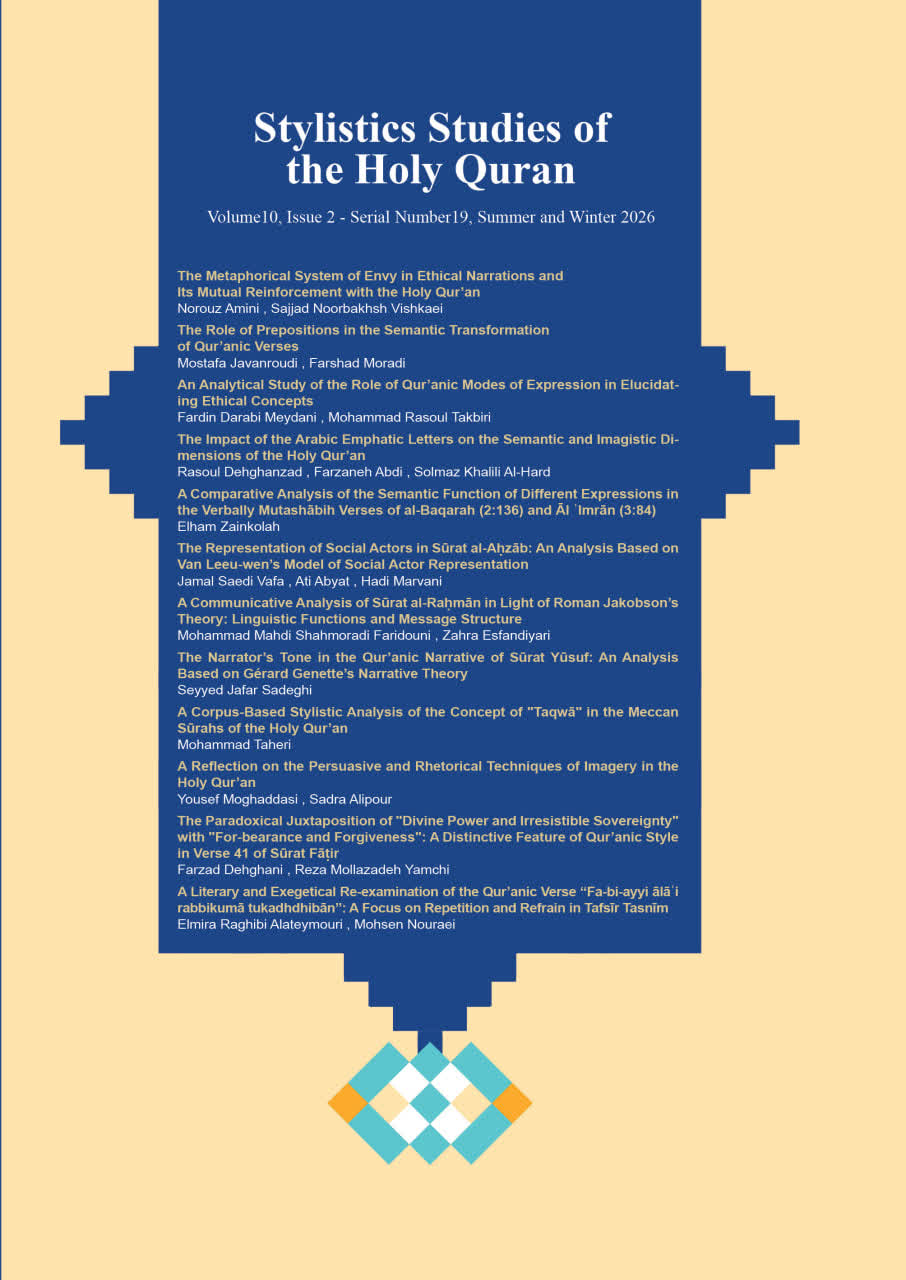
A Corpus-Based Stylistic Analysis of the Concept of "Taqwā" in the Meccan Sūrahs of the Holy Qur’an

Document Type : Original Article

Author
Associate Professor, Department of Persian Language and Literature, Bu-Ali Sina University, Hamedan, Iran.
Abstract
Extended Abstract
Research Objective: This study aims to provide a novel, evidence-based analysis of the central concept of taqwā (God-consciousness) in the formative discourse of Islam and to demonstrate the potential of corpus-based approaches to provide an in-depth and objective analysis of the semantic layers of key concepts in the Holy Qur’an. To this end, it examines the stylistic and semantic dimensions of taqwā across the 86 Meccan Sūrahs of the Qur’an. Drawing on corpus linguistics, the study moves beyond traditional approaches to analysis and maps the semantic network of taqwā through lexical collocation analysis. It investigates the strategic functions of taqwā in two domains: distinguishing the identity of believers and establishing the foundations of Islamic creed (monotheism and eschatology). Specifically, it seeks to answer the following questions: What dimensions of taqwā are highlighted by its patterns of usage during the Meccan period, and how did these patterns contribute to the formation of the identity of the nascent Muslim community?
Research Method: This study adopts a descriptive-analytical method and employs a mixed-methods approach, combining quantitative and qualitative analyses within the framework of corpus linguistics. The research corpus, comprising the complete text of the 86 Meccan Sūrahs, was extracted from Tanzil.net, a reliable digital source. For the quantitative analysis, AntConc software was used to calculate the absolute frequency and distribution of all derivatives of the root w-q-y across the corpus. The analysis focused primarily on lexical collocations, through which statistically significant collocates of the key lexical forms of taqwā within a five-word span to the left and right (L5–R5) were identified using the Log-Likelihood (LL) measure. In the qualitative phase, the extracted collocates were classified into thematic clusters according to their shared semantic domains. The contexts of the relevant Qur’anic verses (concordance lines) were then examined to analyse and interpret the semantic and stylistic implications of these patterns and elucidate the position of taqwā in the Meccan discourse.
Findings: The quantitative analysis revealed that, of the 258 occurrences of the root w-q-y throughout the Qur’an, 154 (approximately 60%) occur in the Meccan Sūrahs. This notably high frequency demonstrates the strategic significance of this concept during the formative period of Islam. Furthermore, the predominance of plural morphological forms, such as al-muttaqīn/al-muttaqūn and yattaqūn, underscores the social and exhortative dimensions of this concept during this period. The most significant findings emerged from the collocation analysis, which revealed a four-dimensional semantic network surrounding the concept of taqwā:

The Cluster of Guidance, Faith, and Certitude: The strong collocational associations of taqwā with words such as hudā (guidance), yuʾminūn (they believe), al-ghayb (the unseen), and al-kitāb (the Book) indicate that taqwā is both a prerequisite for accepting revelation and its natural outcome.
The Cluster of Punishment, Warning, and Eschatological Fear: Significant collocations with terms such as ʿadhāb (punishment), al-nār (the Fire), yawm (the Day of Resurrection), and khawf (fear) demonstrate that fear of divine retribution constitutes one of the principal semantic components of taqwā and serves as a motivation for piety.
The Cluster of Salvation, Prosperity, and Reward: The collocational associations of taqwā with words such as al-mufliḥūn (the successful), al-jannah (Paradise), ajr (reward), and khayr (goodness) highlight its positive dimension as a means of attaining eternal felicity and divine reward, thereby fostering the motivation of hope.
The Cluster of Truth, Veracity, and Divine Command: The association of taqwā with terms such as al-ḥaqq (truth) and al-ṣidq (veracity), together with direct commands to be mindful of Allah and the Lord, demonstrates that taqwā is closely intertwined with adherence to truth, sincerity, and obedience to divine commands.

Conclusion: The concept of taqwā in the Qur’anic discourse of the Meccan period was a multidimensional and fundamental concept that contributed to distinguishing the identity of believers and establishing the foundations of Islamic creed (monotheism and eschatology). It provided an essential framework for shaping the identity of the nascent Muslim community and regulating its relationship with God, revelation, and the Hereafter. The corpus-based analysis demonstrated that this concept is underpinned by a dual motivational structure: on the one hand, fear of divine retribution (the deterrent dimension) and, on the other, hope for salvation and reward (the encouraging dimension). Taqwā is simultaneously presented as a prerequisite for the heart's receptivity to Qur’anic guidance and as a natural outcome of faith in the Qur’an. These findings, supported by quantitative data and statistical analyses, demonstrate that corpus-based methods are effective tools for uncovering the subtle semantic layers and stylistic patterns of the Qur’an and can contribute to a deeper and more objective understanding of its central concepts.
Keywords
Subjects

The Holy Quran
Abd al-Ra'uf, Hussein, (1390 SH), Stylistics of the Holy Quran (linguistic analysis), Translated by Parviz Azadi, Tehran: Imam Sadiq University Press [In Persian].
 Aghaei, Rahim and Mohammad  Rezvani, and Mahdi Haghighi Shirazi, ( 1402 SH), The collocation of paired words and its types in the Holy Quran, Qur'an and Hadith Studies, No. 1, pp. 1-33.  [In Persian].doi:10.30497/qhs.2023.244390.3760
Al-Suyuti, Jalal al-Din 'Abd al-Rahman, (1974), Al-Itqan fi 'Ulum al-Qur'an, Investigated by Muhammad Abu al-Fadl Ibrahim, Al-Hay'ah al-Misriyyah al-'Ammah lil-Kitab [In Arabic].
Al-Zarkashi, Badr al-Din Muhammad ibn Abdullah, (1957), Al-Burhan fi 'Ulum al-Qur'an, Investigated by Muhammad Abu al-Fadl Ibrahim, Cairo: Dar Ihya' al-Kutub al-'Arabiyyah [In Arabic].
Amiri Far, Mohammad and  Kobra Roshanfekr,and  Khalil Parvini and Alieh Kord Zafaranlu Kambuziya,  (1395 SH), Translation challenges in Qur'anic collocations (case study: descriptive and additional compounds), Journal of Qur'an and Hadith Translation Studies, No. 5, pp. 1-25 [In Persian].
Baker, P. (2006). Using corpora in discourse analysis. Continuum
Fa'iz, Qasem, (1378 SH), Criteria for recognizing Meccan and Medinan verses and surahs, Maqalat wa Barrasiha (Articles and Reviews), No. 66, pp. 47-68 [In Persian]. https://jmb.ut.ac.ir/article_12788_fca962b84cbc504ff9e9be6816ea7f28.pdf
Firth, J. R. (1957). A synopsis of linguistic theory, 1930–1955. In Studies in linguistic analysis (pp. 1–31). Blackwell.
Ibn Manzur, Muhammad ibn Mukarram, (1994), Lisan al-Arab, Beirut: Dar Sader [In Arabic].
Izutsu, Toshihiko, (1361 SH), God and man in the Qur'an, Translated by Ahmad Aram, Tehran: Sherkat-e Sahami Enteshar [In Persian].
Keykha, Fatemeh, (1402 SH), Review and analysis of the collocation of Quranic words in the surahs of Hajj, Momenoon, Ra'd and Ibrahim, Zahedan: Diyar-e Aftab [In Persian].
Khakpour, Hossein and  Valiollah Hasoumi and Fatemeh Keykha, (1396 SH), Review and analysis of the lexical collocation of Surah Hajj and Mominoon, Literary Studies of Islamic Texts, No. 2, pp. 9-39.[In Persian]. https://doi.org/10.22081/jrla.2018.49520.1160 
Mahlberg, M. (2007). Corpus stylistics: Bridging the gap between linguistic and literary studies. In M. Hoey, M. Mahlberg, M. Stubbs, & W. Teubert (Eds.), Text, discourse and corpora: Theory and analysis (pp. 219–246). Continuum.
McEnery, T., & Hardie, A. (2012). Corpus Linguistics: Method, Theory and Practice. Cambridge University Press.
McEnery, T., & Wilson, A. (2001). Corpus linguistics: An introduction (2nd ed.). Edinburgh University Press.
Neuwirth, A. (2007). "Orientalism in Oriental Studies? Qur'anic Studies as a Case in Point". Journal of Qur'anic Studies, 9(2), 115–127.
Nohayrat, Ahmad and Ebad Mohammadian, , (1396 SH), Complementary contrastive lexical collocation in the Holy Quran; a case study of verses related to the phrase 'Jannat al-Na'im', Kitab-e Qayyim Biannual Journal, No. 7, pp. 55-76 [In Persian]. https://kq.meybod.ac.ir/article_1126_2fc5c785c110aabb52e55fcecfc3ff93.pdf
Qutb, Sayyid, (1966), Al-Taswir al-Fanni fi al-Qur'an, Cairo: Dar al-Shuruq [In Arabic].
Rayson, P., & Garside, R. (2000). Comparing corpora using frequency profiling. In Proceedings of the Workshop on Comparing Corpora (pp. 1–6). Association for Computational Linguistic.
Roustaei, Alireza and Ali Asghar, Ravanshad (1400 SH), The effect of linguistic context in the selection of collocations of the words of the Holy Quran (case study of Surah Ibrahim),Linguistic Researches of the Qur'an, No. 1, pp. 43-60. https://doi.org/10.22108/nrgs.2021.125953.1605 [In Persian].
Safari, Seyyed Naser, (1374 SH), The concept of piety and its application in the Holy Quran, Qur'anic Researches, No. 4, pp. 251-268 [In Persian]. https://jqr.isca.ac.ir/article_22458_7f65b5ab0058bc5ee4e1a86eccfddfca.pdf
Seyyedi, Seyyed Hossein and Elham Akhlaghi, (1399 SH), A look at the stylistic features of the Holy Quran in word collocations, Mashhad: Islamic Research Foundation [In Persian].
Seyyedi, Seyyed Hossein and Elham Akhlaghi, , (1391 SH), Analysis of the relationship of word collocations in the Holy Quran (case study of Surah Baqarah), Biannual Journal of Quranic and Narrative Studies, No. 2, pp. 9-29 [In Persian]. https://quran.isca.ac.ir/fa/Article/Detail 
Sinclair, J. (1991). Corpus, concordance, collocation. Oxford University Press.
Stubbs, M. (2001). Words and phrases: Corpus studies of lexical semantics. Blackwell.
Volume 10, Issue 2 - Serial Number 19
Volume10, Issue 2 - Serial Number19, Summer And Winter 2026
October 2026
Pages 220-241

  • Receive Date 04 May 2025
  • Revise Date 05 August 2025
  • Accept Date 07 August 2025
  • Publish Date 23 October 2026