Stylistics Studies of the Holy Quran

Stylistics Studies of the Holy Quran

Journal Archive

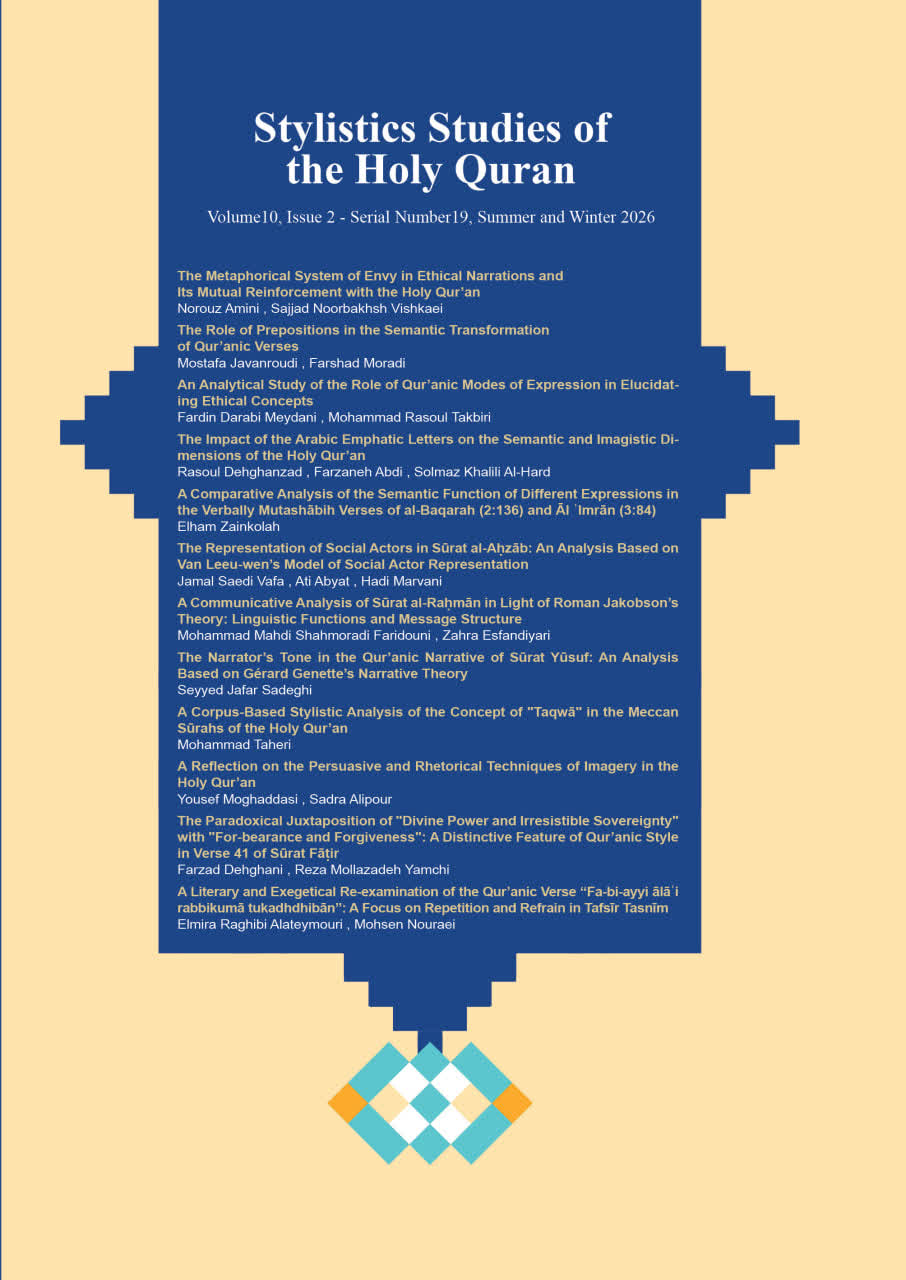
Volume10, Issue 2 - Serial Number19, Summer And Winter 2026
Volume 10, Issue 1 - Serial Number 1۸,Spring&Summer 2026


Number of Volumes 10
Number of Issues 19
Number of Articles 265
Number of Contributors 437
Article View 499171
PDF Download 275,510
View Per Article 1883.66
PDF Download Per Article 1039.66
 
Number of Submissions 685
Rejected Submissions 378
Rejection Rate 55
Accepted Submissions 213
Acceptance Rate 31
Time to Accept (Days) 114
Time to Publish (After Acceptance) (Days) 82
Number of Indexing Databases 5
Number of Reviewers 142


  • Journal Title: Stylistics Studies of the Holy Quran
  • Country of Publication: Iran, Koy
  • Publisher: University of Holy Quran Sciences and knowledge
  • Scientific Sponsorship Society: Linguistic Society of Iran
  • Online ISSN: 2676-6035
  • Frequency: Semiannual
  • Language: Persian, including extended English abstracts and bibliographies.
  • Open Access: Yes, free access to articles
  • Article types: Research and review papers.
  • Primary Review: 2 days, approximately.
  • Peer Review Policy: Double-blind peer-review
  • Average refereeing time: 12-16 weeks
  • Acceptance percentage: 20%
  • Article Processing Charges:  Review: 3.000.000 Rials & Accept: 17.000.000 Rials 
  • Citation Style: The APA referencing style
  • Indexing & Abstracting:  ISC, noormags, Magiran, Iran Journals.
  • COPE: The journal of Stylistics Studies of the Holy Quran follows the policies and guidelines of the Committee on Publication Ethics (COPE) and abides by its Code of Conduct in dealing with potential cases of misconduct. 
  • Copyright: Authors retain unrestricted copyrights and publishing rights.
  • Type of License: CC BY-NC - Creative Commons.
  • The Policy of Screening for Plagiarism: All manuscripts submitted to the journal are screened for potential instances of plagiarism and textual similarity using designated detection software—including iThenticate, SamimNoor, and the IranDoc Similarity Detection System (Hamanjo)—prior to their admission into the peer-review process.
  • Author Identifier: The registration and display of a free ORCID identifier, as well as the use of an academic or institutional email address, are mandatory for all contributing authors. Accordingly, authors are required to obtain their ORCID iD and an academic/institutional email address prior to submitting their manuscript to the journal.
  • Required files to be uploaded: The following files must be submitted through the manuscript submission system: 1. The Main Manuscript File (without the author details and prepared based on the provided template, and 2. Title page in the mentioned format (must include the title of the article and the name and surname of all authors).
Current Issue: Volume 10, Issue 2 - Serial Number 19, October 2026, Pages 8-324 (Volume10, Issue 2 - Serial Number19, Summer And Winter 2026) 

Keywords Cloud

  • Holy Quran
  • Quran
  • stylistics
  • semantics
  • Qur\'an
  • Rhetoric
  • The Holy Quran
  • Holy Qur\'an
  • repetition
  • Phonetic Level
  • an
  • Discourse
  • Conceptual Metaphor
  • the Holy Qur\'an
  • Coherence
  • Semantic
  • imagery
  • Meaning
  • Cognitive Linguistics
  • Holy Qurʾān
  • companionship
  • Arabic Literature
  • context
  • Surah Baqarah
  • Phonetics
  • syntactic layer
  • Qur’anic Rhetoric
  • Discourse Analysis
  • Music
  • Layered Stylistics
  • Linguistics
  • Semantic Relations
  • Implicit Meaning
  • Surah al-Baqarah
  • Roland Barthes
  • Succession
  • conceptual metaphors
  • Qur&rsquo
  • al‑Kashshāf
  • image schemas
  • cognitive semantics
  • Sūrat al-Raḥmān
  • Semiotics
  • Holy Qur’an
  • Verse‑ending (fāṣilah)
  • Metaphor
  • Surah Yusuf
  • lexical layer
  • Semitic Rhetoric
  • Miracles
  • exegesis
  • \"
  • contemplation
  • interpretive methods
  • time
  • Quranic Stories
  • Al-Mizan
  • the language of the Qur\'an
  • translation
  • Deviation
  • critical discourse analysis
  • Quranic discourse
  • Rhythm
  • Semantic network
  • persuasion
  • Lexical Level
  • Noble Qur\'an
  • \"Holy Quran\"
  • Quranic Stylistics
  • The Holy Qur’an
  • ethics
  • grammatical level
  • \"Allameh Tabatabai\"
  • Surah Takwir
  • Effective Communication
  • Message
  • Surah Anfal
  • Jakobson
  • Expression
  • story
  • rhetorical level
  • Quranic doubts
  • structural analysis
  • Persian Translation of the Qur\'an
  • al‑Zamakhsharī
  • Qur’an
  • Linguistic level
  • divine mercy
  • The beauties of the Qur\'an
  • al-Tafseer al-Bayani
  • Substitution Relationship
  • Qur\'anic stories
  • serious will
  • interpersonal metafunction
  • phonetic implications (meanings)
  • abbreviation
  • Employability
  • translations of the Qur\'
  • Persian translation
  • the proportions of \"Favasel\"
  • Prophet Ayyub (Job)
  • Qur&‌‌‌‌‌‌‌rsquo
  • commentators
  • the Holy Qur’an
  • Qasur
  • Jesus (pbuh)
  • \"Method of phonetic interpretation\"
  • Quran Interpretation
  • righteous deeds
  • Syntactic problems
  • An-Naba (Announcement)
  • Parallelism
  • ). Accordingly, the exception appears outwardly to be disconnected and Iblīs is not counted among the angels
  • Tafsir of the Qur\'an
  • Functional Linguistics
  • standard traditions
  • interpretive-analytical translation
  • Quranic Method
  • \"Literary Sciences\"
  • Spatio-temporal Continuum
  • Keywords: Usage
  • eloquent simile
  • Surah Al-Shu\'ara
  • Quran calligraphy
  • story - Story terminology
  • Chronological Order of Revelation
  • Surah Qamar
  • Relational Semantic
  • fundamental words
  • executive guarantee
  • \"revelational (Tanzili) procedure\"
  • Persian
  • antihero
  • Paul Simpson
  • coexistence axis
  • \"Quran\"
  • fundamentals of interpretation
  • Quantitative Qur’anic Analysis
  • story of Adam (pbuh)
  • letter Jarr
  • Surah Infatar
  • Alphabet
  • Quranic commentary
  • introduction and lateness
  • Sūrat al-Baqarah (Qur’an 2)
  • Surah Qalam
  • Van Leeuwen Pattern
  • Imaginative
  • Permitted
  • word
  • \" Invisible repetitions\"
  • Language roles
  • \"Geometric Structure\"
  • thus making the exception connected? Or is the exception disconnected, such that it does not include Iblīs&‌‌‌‌mdash
  • \"HEENa\"
  • Efficiency
  • The Holy Qur\'\'an
  • Javadi Amoli
  • Qur’anic Ethical Concepts
  • analytical library-based method and attempts, through direct reference to the exegetical works of Shaykh Ṭūsī in al‑Tibyān and Ayatollah Javadi Amoli&‌‌‌‌rsquo
  • koranic sura
  • Qur\'anic narrative
  • l‑kāfirīn (&‌‌‌‌ldquo
  • name-mapping
  • Phonological Motivation
  • guidance and misguidance
  • People of Saba’
  • Ṣaḥīfah Sajjadiyyah
  • Letter Features
  • anic oaths
  • Intertextual Reading
  • Sūrat Yūsuf
  • The purpose of the chapter
  • phonetic layer
  • Communication Implication
  • Al-Mīzān fī Tafsīr al-Qurʾān
  • Genealogy
  • Zakat
  • Meccan chapters
  • metaphorical verses
  • Chronotope
  • Attributive function
  • Circular Composition
  • wisdom
  • moral statements
  • Adjacent Surah
  • Harmony
  • Distance
  • linguistic functions
  • Surah Esra \'
  • Sensation
  • Morphology Layer
  • phonetic and lexical stylistics
  • semantic continuity
  • Highlighting
  • Verses of Sakīnah
  • mirror composition
  • he became&‌‌‌‌rdquo
  • the model of Grimas
  • Judicial Trustee

Related Journals