Stylistics Studies of the Holy Quran

Stylistics Studies of the Holy Quran

Number of Volumes 10
Number of Issues 18
Number of Articles 265
Number of Contributors 437
Article View 491140
PDF Download 272,260
View Per Article 1853.36
PDF Download Per Article 1027.4
Number of Submissions 672
Rejected Submissions 371
Reject Rate 55
Accepted Submissions 211
Acceptance Rate 31
Time to Accept (Days) 114
Number of Indexing Databases 5
Number of Reviewers 140


  • Journal Title: Stylistics Studies of the Holy Quran
  • Country of Publication: Iran, Koy
  • Publisher: University of Holy Quran Sciences and knowledge
  • Scientific Sponsorship Society: Linguistic Society of Iran
  • Online ISSN: 2676-6035
  • Frequency: Semiannual
  • Language: Persian, including extended English abstracts and bibliographies.
  • Open Access: Yes, free access to articles
  • Article types: Research and review papers.
  • Primary Review: 2 days, approximately.
  • Peer Review Policy: Double-blind peer-review
  • Average refereeing time: 12-16 weeks
  • Acceptance percentage: 20%
  • Article Processing Charges:  Review: 3.000.000 Rials & Accept: 17.000.000 Rials 
  • Citation Style: The APA referencing style
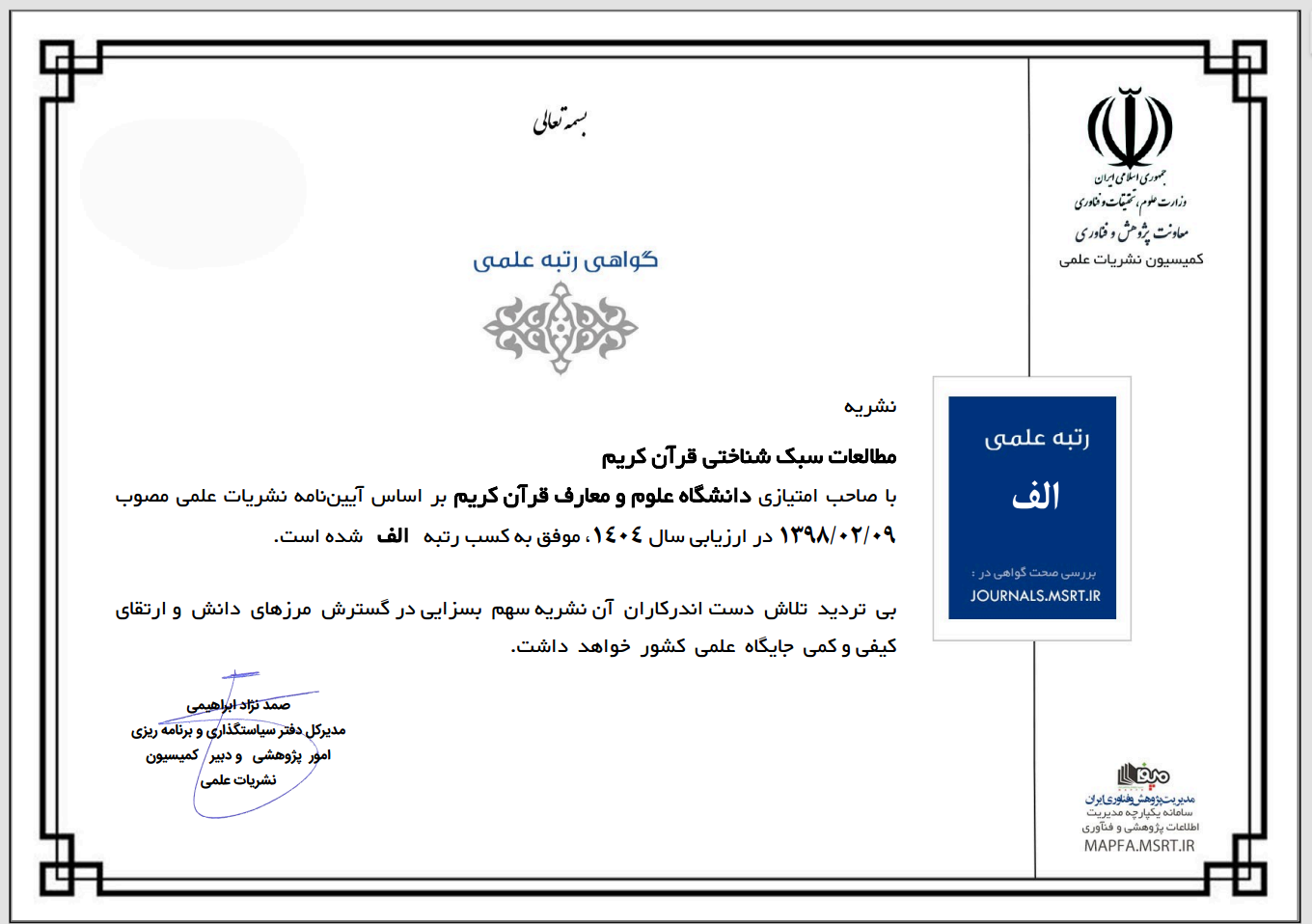
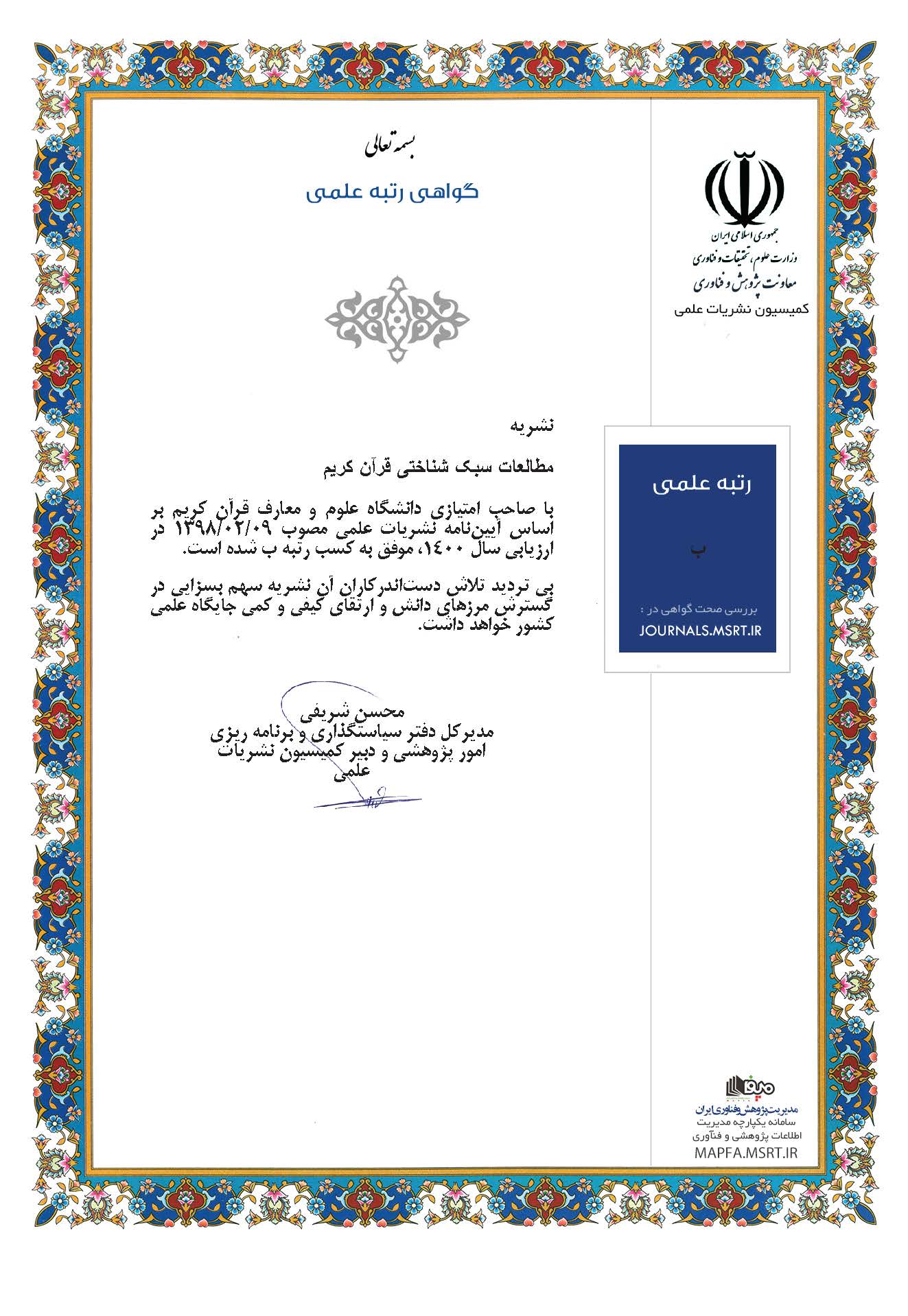
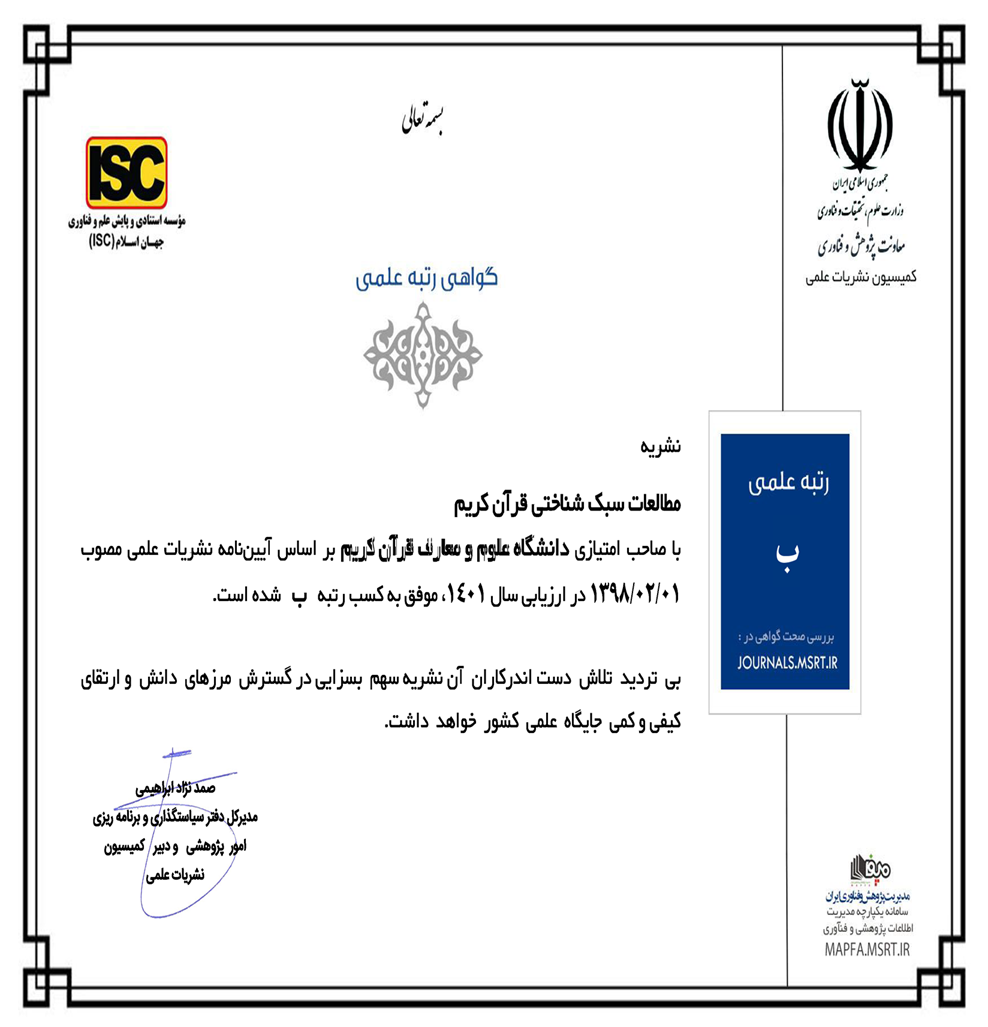
  • Indexing & Abstracting:  ISC, noormags, Magiran, Iran Journals.
  • COPE: The journal of Stylistics Studies of the Holy Quran follows the policies and guidelines of the Committee on Publication Ethics (COPE) and abides by its Code of Conduct in dealing with potential cases of misconduct. 
  • Copyright: Authors retain unrestricted copyrights and publishing rights.
  • Type of License: CC BY-NC - Creative Commons.
  • The Policy of Screening for Plagiarism: All manuscripts submitted to the journal are screened for potential instances of plagiarism and textual similarity using designated detection software—including iThenticate, SamimNoor, and the IranDoc Similarity Detection System (Hamanjo)—prior to their admission into the peer-review process.
  • Author Identifier: The registration and display of a free ORCID identifier, as well as the use of an academic or institutional email address, are mandatory for all contributing authors. Accordingly, authors are required to obtain their ORCID iD and an academic/institutional email address prior to submitting their manuscript to the journal.
  • Required files to be uploaded: The following files must be submitted through the manuscript submission system: 1. The Main Manuscript File (without the author details and prepared based on the provided template, and 2. Title page in the mentioned format (must include the title of the article and the name and surname of all authors).
Current Issue: Volume 10, Issue 18, May 2026, Pages 8-305 (Volume 10, Issue 1 - Serial Number 1۸,Spring&Summer 2026) 

Keywords Cloud

  • Holy Quran
  • Quran
  • stylistics
  • semantics
  • Qur\'an
  • Rhetoric
  • The Holy Quran
  • Holy Qur\'an
  • Phonetic Level
  • repetition
  • an
  • Discourse
  • companionship
  • Conceptual Metaphor
  • Cognitive Linguistics
  • Holy Qurʾān
  • Meaning
  • Coherence
  • the Holy Qur\'an
  • Semantic
  • Phonetics
  • Surah Baqarah
  • Metaphor
  • Arabic Literature
  • Linguistics
  • syntactic layer
  • Expression
  • Layered Stylistics
  • imagery
  • Surah Yusuf
  • Music
  • al‑Zamakhsharī
  • Miracles
  • \"
  • Succession
  • Roland Barthes
  • Quranic discourse
  • \"Holy Quran\"
  • image schemas
  • Quranic Stories
  • interpretive methods
  • Jakobson
  • Message
  • Semiotics
  • Quranic doubts
  • Semitic Rhetoric
  • lexical layer
  • Qur’an
  • Rhythm
  • Implicit Meaning
  • story
  • Surah al-Baqarah
  • rhetorical level
  • Persian Translation of the Qur\'an
  • translation
  • \"Allameh Tabatabai\"
  • Verse‑ending (fāṣilah)
  • cognitive semantics
  • Al-Mizan
  • structural analysis
  • Semantic Relations
  • Surah Ar-Rahman
  • critical discourse analysis
  • al‑Kashshāf
  • Quranic Stylistics
  • persuasion
  • Semantic network
  • Deviation
  • Qur&rsquo
  • Lexical Level
  • grammatical level
  • Discourse Analysis
  • Surah Takwir
  • the language of the Qur\'an
  • Effective Communication
  • Surah Anfal
  • contemplation
  • time
  • context
  • Noble Qur\'an
  • conceptual metaphors
  • linguistic functions
  • Holy Qur’an
  • ethics
  • Surah Al-Ahzab
  • story - Story terminology
  • phonetic implications (meanings)
  • De Beaugrande&‌rsquo
  • Keywords: Usage
  • Employability
  • envy
  • Persian translation
  • interpretive-analytical translation
  • \"Literary Sciences\"
  • the Holy Qur’an
  • Persian
  • antihero
  • Surah Infatar
  • Quranic Wilayah Verses
  • fundamental words
  • An-Naba (Announcement)
  • letter Jarr
  • Qur&‌‌‌‌‌‌‌rsquo
  • \"Method of phonetic interpretation\"
  • Qasur
  • commentators
  • Syntactic problems
  • syllabic letters
  • translations of the Qur\'
  • Parallelism
  • ). Accordingly, the exception appears outwardly to be disconnected and Iblīs is not counted among the angels
  • Tafsir of the Qur\'an
  • Functional Linguistics
  • standard traditions
  • \"Quran\"
  • Quranic Method
  • Substitution Relationship
  • Spatio-temporal Continuum
  • word
  • eloquent simile
  • divine mercy
  • Quran calligraphy
  • Jesus (pbuh)
  • Kinship Relations
  • Chronological Order of Revelation
  • favor
  • Surah Qamar
  • story of Adam (pbuh)
  • Quran Interpretation
  • righteous deeds
  • Surah Qalam
  • Javadi Amoli
  • Relational Semantic
  • executive guarantee
  • Permitted
  • \"revelational (Tanzili) procedure\"
  • mirror composition
  • Paul Simpson
  • \"Geometric Structure\"
  • People of Saba’
  • central concepts
  • Al-Baqarah
  • fundamentals of interpretation
  • Morphology Layer
  • The Holy Qur\'\'an
  • introduction and lateness
  • Van Leeuwen Pattern
  • koranic sura
  • Surah Ash-Shams
  • Imaginative
  • \" Invisible repetitions\"
  • the model of Grimas
  • Language roles
  • Efficiency
  • guidance and misguidance
  • syntactic structure
  • Story of Prophet Yusuf
  • Qur\'anic narrative
  • \"HEENa\"
  • Phonological Motivation
  • Verses of Sakīnah
  • phonetic layer
  • Support
  • Central Matrix
  • anic oaths
  • Letter Features
  • Izutsu
  • The purpose of the chapter
  • Ṣaḥīfah Sajjadiyyah
  • Al-Mīzān fī Tafsīr al-Qurʾān
  • name-mapping
  • Genealogy
  • Zakat
  • Meccan chapters
  • metaphorical verses
  • Chronotope
  • Circular Composition
  • wisdom
  • Attributive function
  • moral statements
  • Adjacent Surah
  • Harmony
  • Distance
  • Symbol
  • Surah Esra \'
  • Sensation
  • the story of breaking idol and thorwn into the fire of hazrat Ibrahim
  • phonetic and lexical stylistics
  • semantic continuity
  • coexistence axis
  • Intertextual Reading
  • Communication Implication
  • Drama
  • Dormant
  • Medinan chapters
  • Surah Nisa
  • Systemic functional linguistics
  • Qur&‌‌‌‌‌rsquo
  • Holly Quran
  • Highlighting

Related Journals